AGENTIC DESIGN PRACTICE
Designing in an agentic world means getting serious about what users actually need from systems that act on their behalf.
What's already becoming clear is that agentic systems are forcing a different set of design questions to the surface. When software can anticipate, decide, and act without constant instruction, the criteria that always mattered most become impossible to avoid.
What great UX looks like when the software is doing the work.
Does the user trust it enough to let it run?
Does it know when to guide versus when to step aside?
Does the outcome match what the user actually needed?
These questions get sharp quickly in high-stakes environments. I've been working through them in government finance, where a system that hallucinates doesn't fail a usability test. It fails the public institution behind it. That context shaped how I think about what agentic experiences require from a designer, and I'm bringing those lessons into new territory.
This page shows what I've shipped and what's in progress, what I've learned, and where I'm still actively working things out.
AI Projects: Shipped and In Progress
Some of these are shipped and in production. Some are still in progress. All of them reflect how AI is changing what's possible in the design process.

AI Chat for Digital Budget Books
The hypothesis was simple: residents shouldn't navigate 400 pages of government financial documents to get a question answered. But deploying a conversational AI in a government trust environment meant solving one thing first - the system could never appear to make things up.
We used Gemini Deep Research to map the failure modes before designing anything. Hallucinations, source verification gaps, statistical integrity errors, out-of-scope political questions. Each one became a design constraint.
The citation system came directly from that process. Every response links to the exact source page with the relevant section highlighted. The chatbot stays persistent in the sidebar so users can move between citations and conversation without losing their place. The design is essentially telling users: don't trust me, verify me. That's the right posture for government finance. I'd argue it's the right posture for most agentic systems in high-stakes environments.
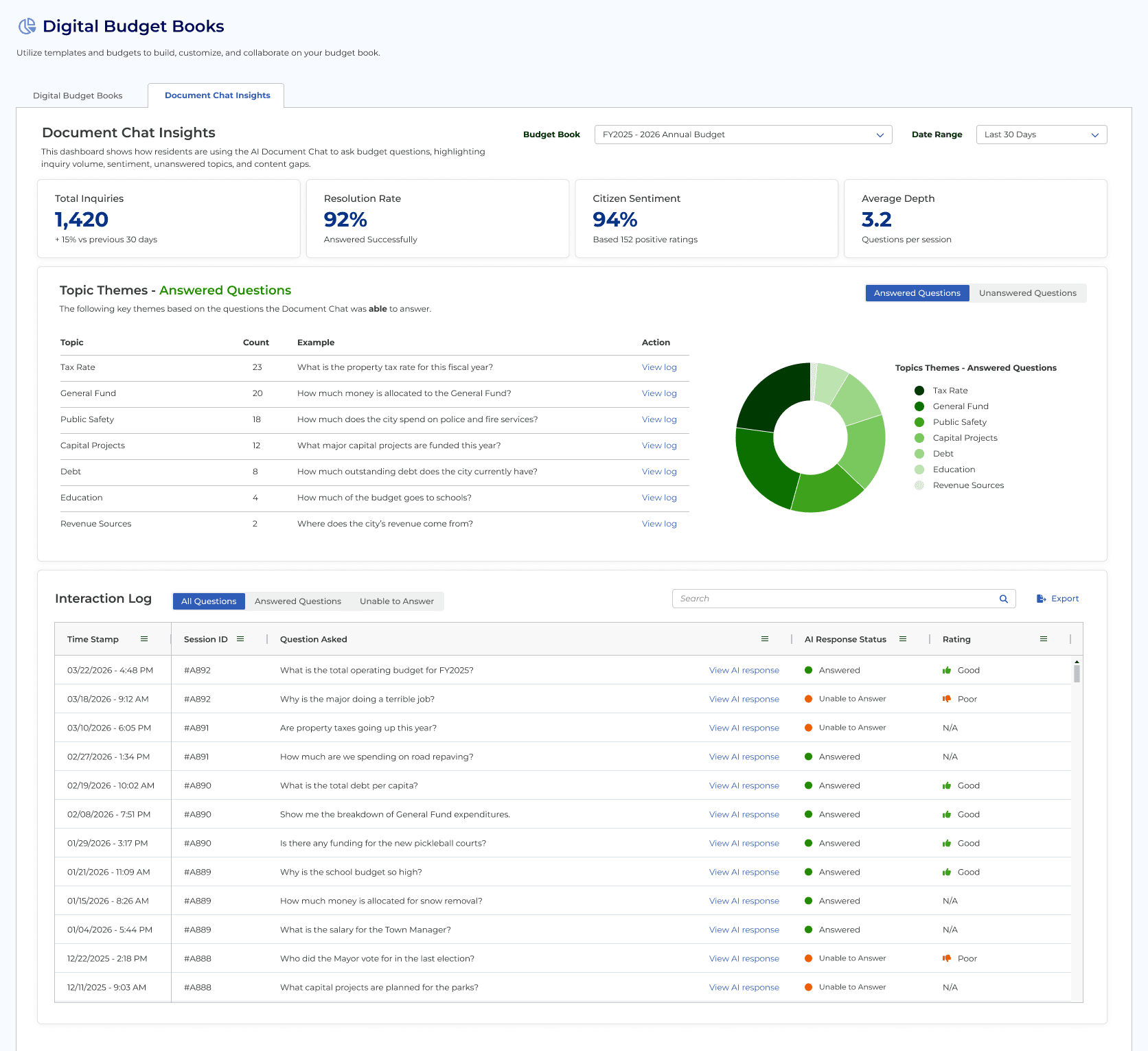
I also led the Document Chat Insights dashboard. Finance Directors needed visibility into what residents were asking, where the AI was performing well, and where it wasn't. That dashboard became a feedback loop for improving the system over time.
What this clarified: trust and anticipation aren't in tension. A system that shows its work is the one users let run without anxiety.
Post-Merger Unified UX Exploration & Stress Testing

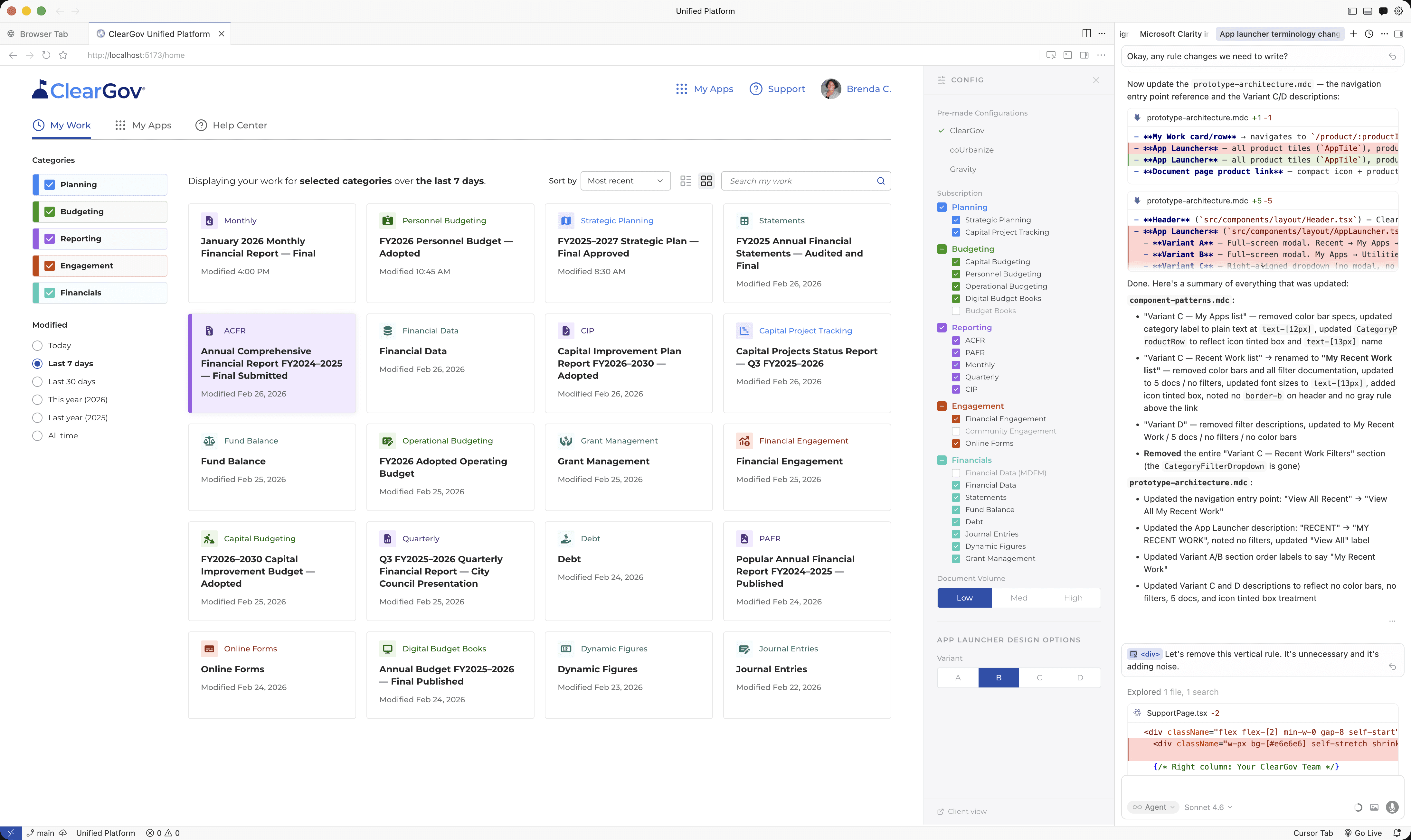
ClearGov's largest initiative after acquisition: unifying the experience across four companies brought together through the merger.
The complexity was structural. Dozens of subscriber levels and feature variable combinations, any one of which could expose an edge case. I built a custom configuration tool in Cursor to stress-test every combination before any stakeholder saw the design. That tool wasn't a deliverable. It was a method for making design intent precise enough to survive an AI-assisted engineering workflow without drift.
Visual UI through Figma MCP + Cursor. Interactive prototypes deployed to Vercel for internal and client testing. Moving toward automated developer handoff packages for direct engineering ingestion.
What this clarified: when engineers are moving fast using AI-assisted development, ambiguity in design is expensive. Precision isn't a nice-to-have, it's the job.
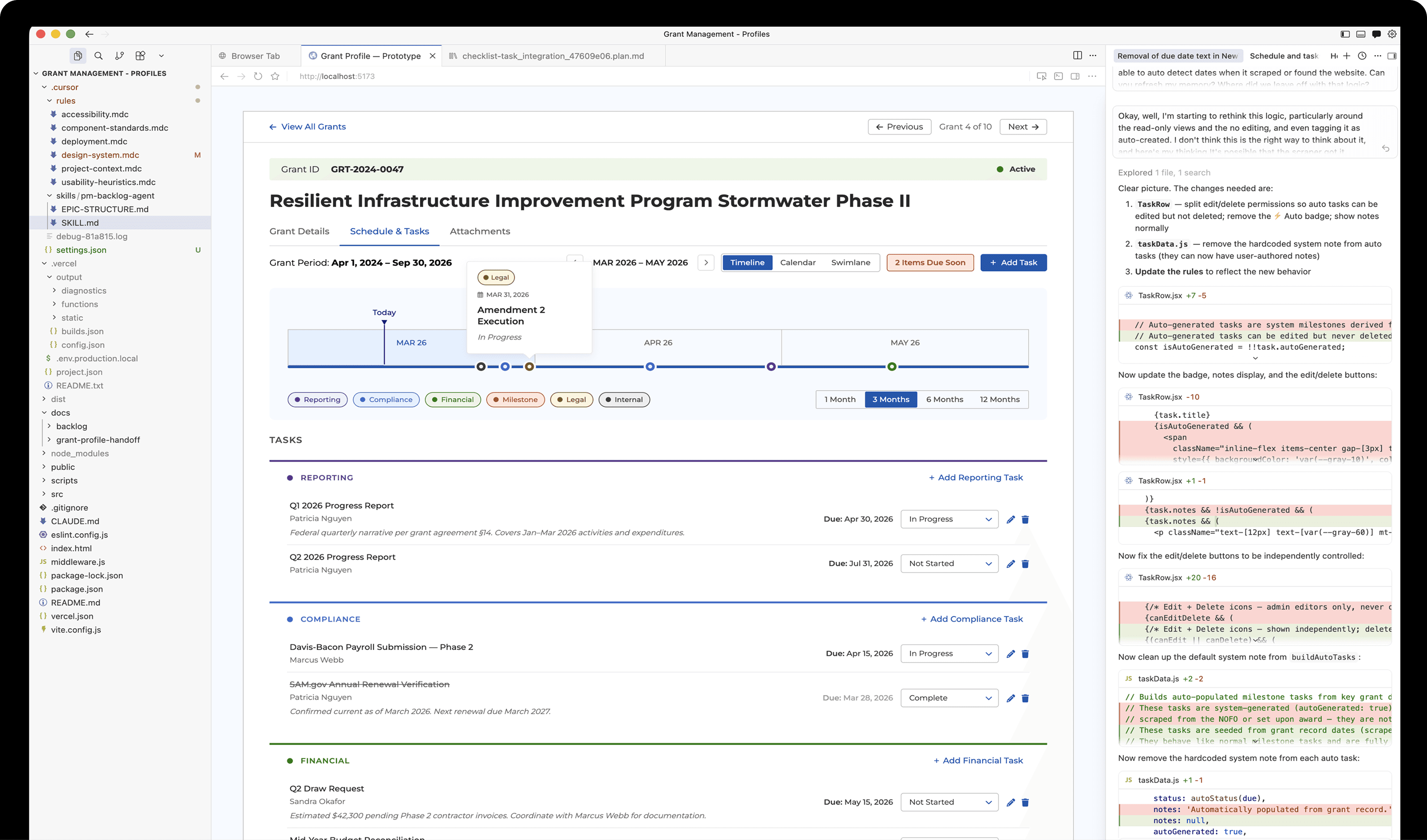
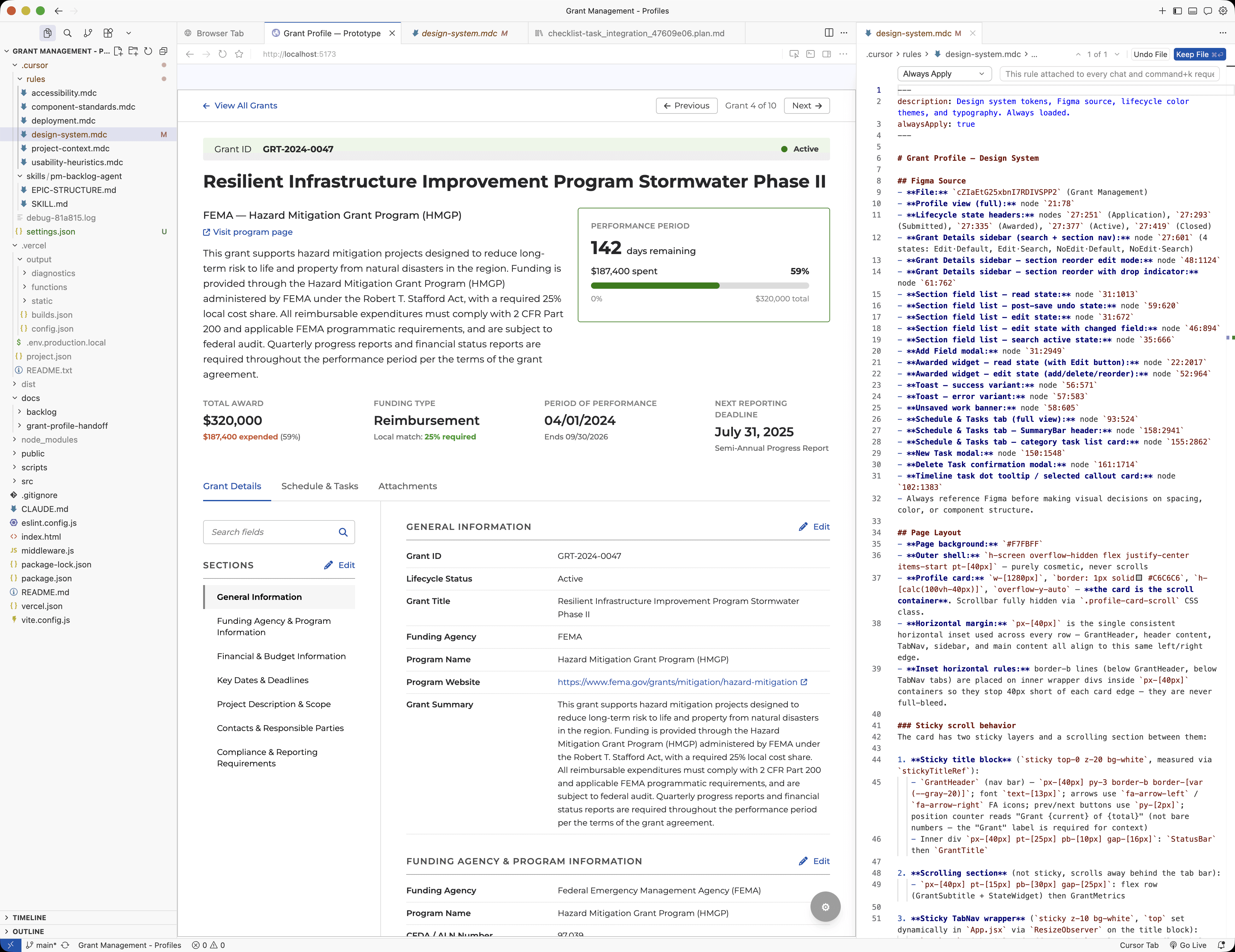
Grant Management
A new grant management product covering profiles, timelines, and task management across full grant lifecycles.
First project where I moved directly from discovery research into coded prototypes using Cursor and Claude, skipping an intermediate wireframe phase. The concept-to-validation cycle compressed significantly. Figma MCP kept design system tokens intact through to implementation. Developer handoff included working component code alongside specs.
What surprised me was how much mental space opened up once the scaffolding was handled. Without a wireframing phase consuming the middle of the process, I could spend that time on something harder: exploring different logical architectures for how users would actually move through and extract information from the product. Less time on presentation, more time on intent. What does a grant manager need to see first? What does a completed workflow actually feel like? Those questions got more attention than they typically do, and it showed in the quality of the validation conversations with users.
What this clarified: removing the wireframe phase doesn't remove the thinking. It moves it earlier and demands more precision upfront.

UX Research Advisor App
An internal tool for the ClearGov design team, built with Claude Code and deployed via Vercel.
The problem: designers defaulting to familiar research methods rather than the right one for each project. The tool asks three focused questions and returns ranked recommendations from Nielsen Norman Group's 20 UX research methodologies, each with a rationale and a direct NN/g link.
Small tool. But it represents something I keep coming back to: the most durable use of AI is improving how a team works, not just what it ships. I've documented this workflow and trained other designers on it. What starts as a personal method becomes a team standard.

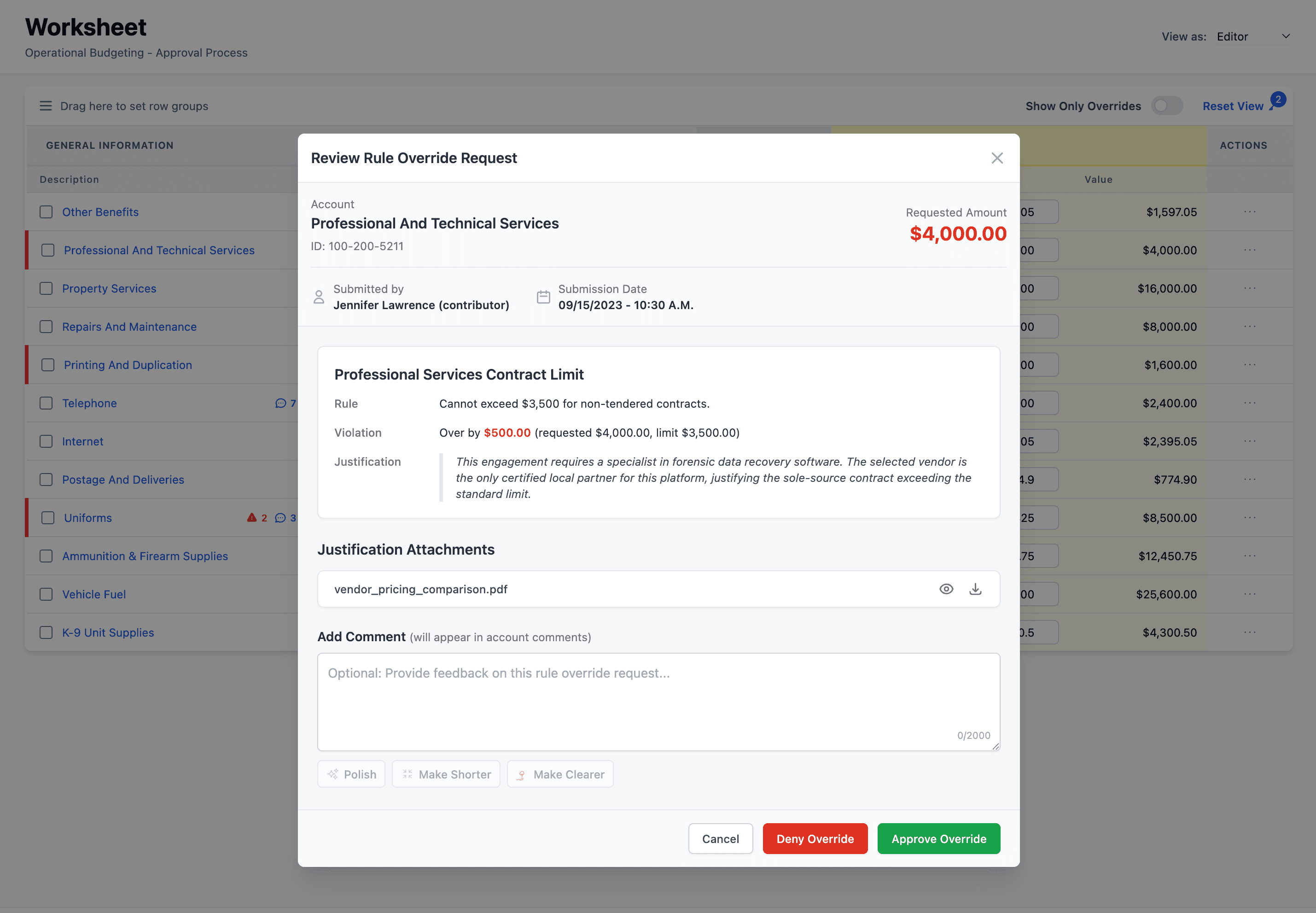
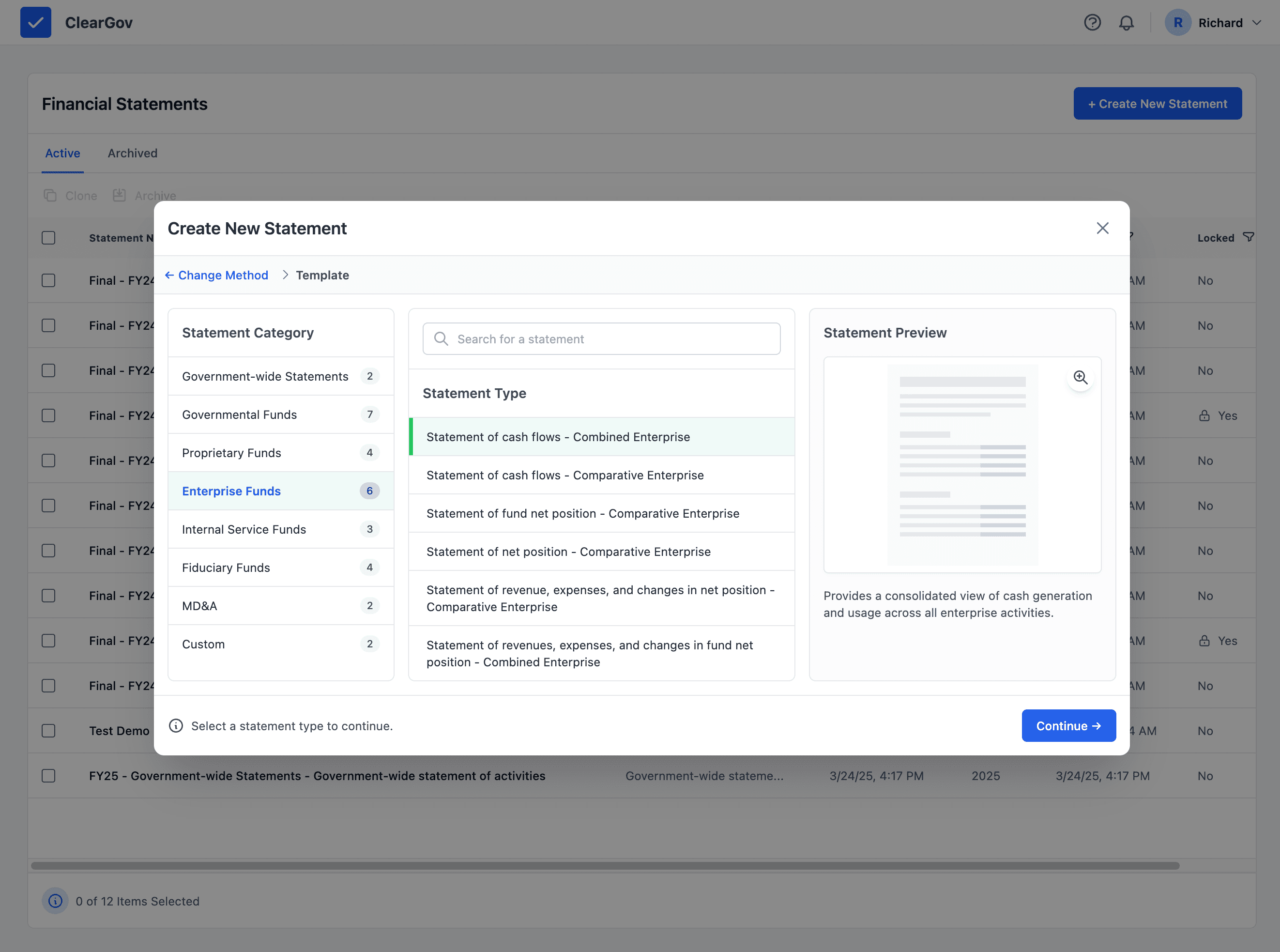
Budgeting Workflow Prototypes
Two complex workflows that needed validation before committing to backend development.
Used Google AI Studio and the Gemini API to build high-fidelity React/Tailwind prototypes fast enough for real client testing. The first was an AI-assisted justification workflow for budget rule violations. The second was a Financial Statement Builder with confidence scoring and a human-in-the-loop validation wizard.
Both surfaced edge cases and cross-functional dependencies that wouldn't have appeared in a static spec. Getting to high fidelity fast means finding the hard problems before the cost of changing course gets high.
How I work
When a method, approach or tooling proves its value, it doesn't stay a personal workaround. I document new workflows, train designers on updated methods, and work directly with engineers on integration points.
Research & Synthesis
Google Gemini - broad research, competitive analysis, risk synthesis
NotebookLM - user research synthesis, pattern identification
Claude Deep Research - market intelligence for complex problem spaces
Planning & Definition
Claude Projects - strategic planning, context management across long project cycles
Gemini Gems - custom assistants for recurring planning tasks
Prototype & Build
Cursor + Claude + Figma MCP - production-grade prototypes using real design system tokens; developer-ready handoff code
Google AI Studio + Gemini API - mid-fidelity React/Tailwind prototypes
Deploy & Test
Vercel + GitHub - deployed prototypes for live client and stakeholder testing
Articos / Uxia — Exploring synthetic research platforms for early discovery validation and prototype testing between human research cycles.